DBHub: Universal database gateway to view SQLite database, run sequel queries & browse tables. Secure, safe, and easy-to
Enable Claude to query your database directly using natural language
Example: Ask 'Show me top 10 customers by revenue this month' and get SQL results instantly
Eliminate manual SQL writing for ad-hoc queries, get insights 10x faster
Generate complex reports and analytics without leaving conversation
Example: Analyze sales trends, cohort retention, user behavior patterns conversationally
Democratize data access—non-technical team members can query databases
Understand database structure, relationships, and data models
Example: 'Explain the user_orders table schema and its relationships'
Onboard engineers faster, explore unfamiliar databases efficiently
Run data quality queries to catch anomalies and inconsistencies
Example: Find duplicate records, missing values, orphaned foreign keys automatically
Maintain data integrity with less manual SQL work
Unified.to MCP Server
The most comprehensive MCP integration platform with 333+ integrations and 20,421+ real-time tools. Connect your AI assi
Datadog
MCP server for Datadog — enables Claude to interact with Datadog data and workflows.
eRegulations
eRegulations makes admin procedure data easy to access, helping users understand the Administrative Procedure Act seamle
GitHub
MCP server for GitHub — enables Claude to interact with GitHub data and workflows.
Arize Phoenix
Arize Phoenix — unified interface for managing prompts, exploring datasets, and running LLM experiments across providers
Strong directory entry: DBHub (Universal Database Gateway) surfaces stars and publisher context so we could sanity-check maintenance before adopting.
I recommend DBHub (Universal Database Gateway) for teams standardizing on MCP; the explainx.ai page compares cleanly with sibling servers.
We evaluated DBHub (Universal Database Gateway) against two servers with overlapping tools; this profile had the clearer scope statement.
DBHub (Universal Database Gateway) has been reliable for tool-calling workflows; the MCP profile page is a good permalink for internal docs.
According to our notes, DBHub (Universal Database Gateway) benefits from clear Model Context Protocol framing — fewer ambiguous “AI plugin” claims.
DBHub (Universal Database Gateway) is among the better-indexed MCP projects we tried; the explainx.ai summary tracks the official description.
We wired DBHub (Universal Database Gateway) into a staging workspace; the listing’s GitHub and npm pointers saved time versus hunting across READMEs.
We evaluated DBHub (Universal Database Gateway) against two servers with overlapping tools; this profile had the clearer scope statement.
DBHub (Universal Database Gateway) is a well-scoped MCP server in the explainx.ai directory — install snippets and categories matched our Claude Code setup.
DBHub (Universal Database Gateway) is among the better-indexed MCP projects we tried; the explainx.ai summary tracks the official description.
showing 1-10 of 27
Share your MCP server with the developer community
 by bytebase
Select a client to integrate this server.
Claude Desktop configuration
{
  "mcpServers": {
    "dbhub-demo": {
      "command": "npx",
      "args": [
        "-y",
        "@bytebase/dbhub",
        "--transport",
        "stdio",
        "--demo"
      ]
    }
  }
}Connects to PostgreSQL, MySQL, SQLite, and DuckDB databases through a unified interface. Execute read-only SQL queries and browse database schemas safely.
DBHub (Universal Database Gateway) is an official MCP server published by bytebase that provides AI assistants with tools and capabilities via the Model Context Protocol. DBHub: Universal database gateway to view SQLite database, run sequel queries & browse tables. Secure, safe, and easy-to It is categorized under databases, developer tools. This server exposes 2 tools that AI clients can invoke during conversations and coding sessions.
You can install DBHub (Universal Database Gateway) in your AI client of choice. Use the install panel on this page to get one-click setup for Cursor, Claude Desktop, VS Code, and other MCP-compatible clients. This server runs locally on your machine via the stdio transport.
<p align="center"> <a href="https://dbhub.ai/" target="_blank"> <picture> <source media="(prefers-color-scheme: dark)" srcset="https://raw.githubusercontent.com/bytebase/dbhub/main/docs/images/logo/full-dark.svg" width="75%"> <source media="(prefers-color-scheme: light)" srcset="https://raw.githubusercontent.com/bytebase/dbhub/main/docs/images/logo/full-light.svg" width="75%"> <img src="https://raw.githubusercontent.com/bytebase/dbhub/main/docs/images/logo/full-light.svg" width="75%" alt="DBHub Logo"> </picture> </a> </p>[!NOTE]
Brought to you by Bytebase, open-source database DevSecOps platform.
            +------------------+    +--------------+    +------------------+
            |                  |    |              |    |                  |
            |                  |    |              |    |                  |
            |  Claude Desktop  +--->+              +--->+    PostgreSQL    |
            |                  |    |              |    |                  |
            |  Claude Code     +--->+              +--->+    SQL Server    |
            |                  |    |              |    |                  |
            |  Cursor          +--->+    DBHub     +--->+    SQLite        |
            |                  |    |              |    |                  |
            |  VS Code         +--->+              +--->+    MySQL         |
            |                  |    |              |    |                  |
            |  Copilot CLI     +--->+              +--->+    MariaDB       |
            |                  |    |              |    |                  |
            |                  |    |              |    |                  |
            +------------------+    +--------------+    +------------------+
                 MCP Clients           MCP Server             Databases
DBHub is a zero-dependency, token efficient MCP server implementing the Model Context Protocol (MCP) server interface. This lightweight gateway allows MCP-compatible clients to connect to and explore different databases:
PostgreSQL, MySQL, SQL Server, MariaDB, and SQLite.
DBHub implements MCP tools for database operations:
dbhub.toml configuration fileDBHub includes a built-in web interface for interacting with your database tools. It provides a visual way to execute queries, run custom tools, and view request traces without requiring an MCP client.
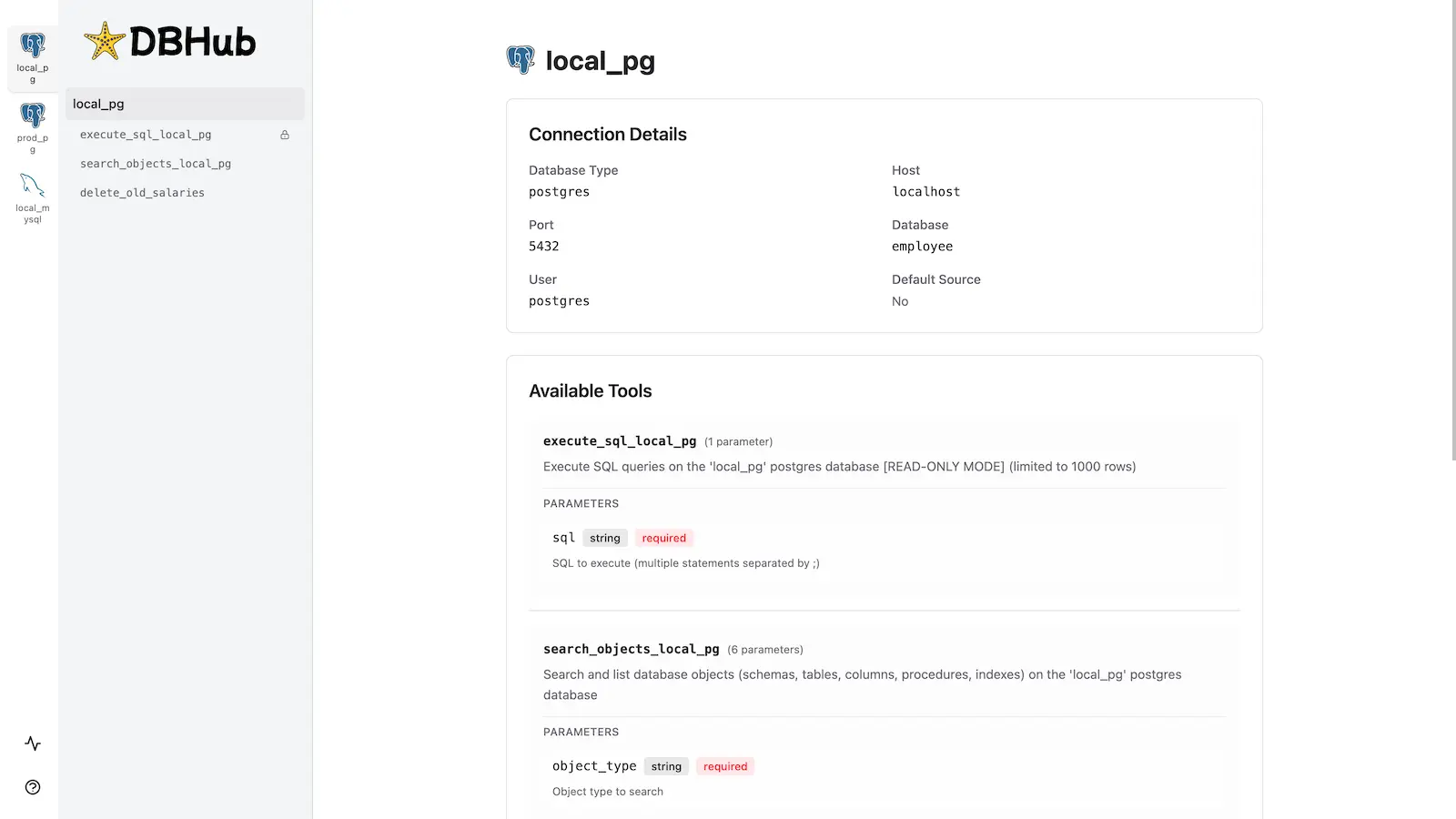
See the full Installation Guide for detailed instructions.
Docker:
docker run --rm --init \
   --name dbhub \
   --publish 8080:8080 \
   bytebase/dbhub \
   --transport http \
   --port 8080 \
   --dsn "postgres://user:password@localhost:5432/dbname?sslmode=disable"
NPM:
npx @bytebase/dbhub@latest --transport http --port 8080 --dsn "postgres://user:password@localhost:5432/dbname?sslmode=disable"
Demo Mode:
npx @bytebase/dbhub@latest --transport http --port 8080 --demo
See Command-Line Options for all available parameters.
Connect to multiple databases simultaneously using TOML configuration files. Perfect for managing production, staging, and development databases from a single DBHub instance.
See Multi-Database Configuration for complete setup instructions.
# Install dependencies
pnpm install

# Run in development mode
pnpm dev

# Build and run for production
pnpm build && pnpm start --transport stdio --dsn "postgres://user:password@localhost:5432/dbname"
Time estimate: 15-30 minutes including configuration and testing
Prerequisites
Steps
Troubleshooting
✓ Do
✗ Don't
💡 Pro Tips
Architecture
MCP server acts as bridge between Claude and database, translating natural language to SQL queries and returning results in structured format.
Protocols
Compatibility
✓ Use when
Use for ad-hoc data queries, exploratory analysis, report generation, schema exploration, and democratizing data access. Best for read-heavy analytics workloads.
✗ Avoid when
Avoid for production write operations, mission-critical transactions, real-time OLTP workloads, or when database contains sensitive PII without proper access controls. Use read replicas, not primary.
Desktop Commander MCP
Terminal control, file system search, and diff-based file editing for Claude and other AI assistants. Execute shell comm



