



Keep up with every AI tool and regulation change that matters for HR. explainx.ai gives HR professionals access to curated AI skills, daily news, monthly courses, and an AI chatbot — $29/month to stay current without spending hours curating your own reading list.
HR is simultaneously one of the most promising and most sensitive areas for AI application. Promising because so much of HR work involves structured, repetitive, document-heavy tasks that AI handles well — job descriptions, policy communications, onboarding content, benefits FAQs. Sensitive because HR decisions have direct consequences for people's careers, livelihoods, and wellbeing, and AI failure modes — hallucination, bias amplification, context errors — carry serious risks in that context.
The HR professionals navigating this well in 2026 are not the ones who have automated the most. They are the ones who have developed a clear mental model of which HR tasks benefit from AI assistance, which require significant caution, and which should remain fully human — and they build verification habits at every step.
This guide covers each major HR function with specific, practical guidance on where AI helps, where the risks require careful design, and what to watch out for. Pair with AI for business leaders for executive framing and AI for mental health for employee-support and EAP-adjacent tools.
Talent Acquisition
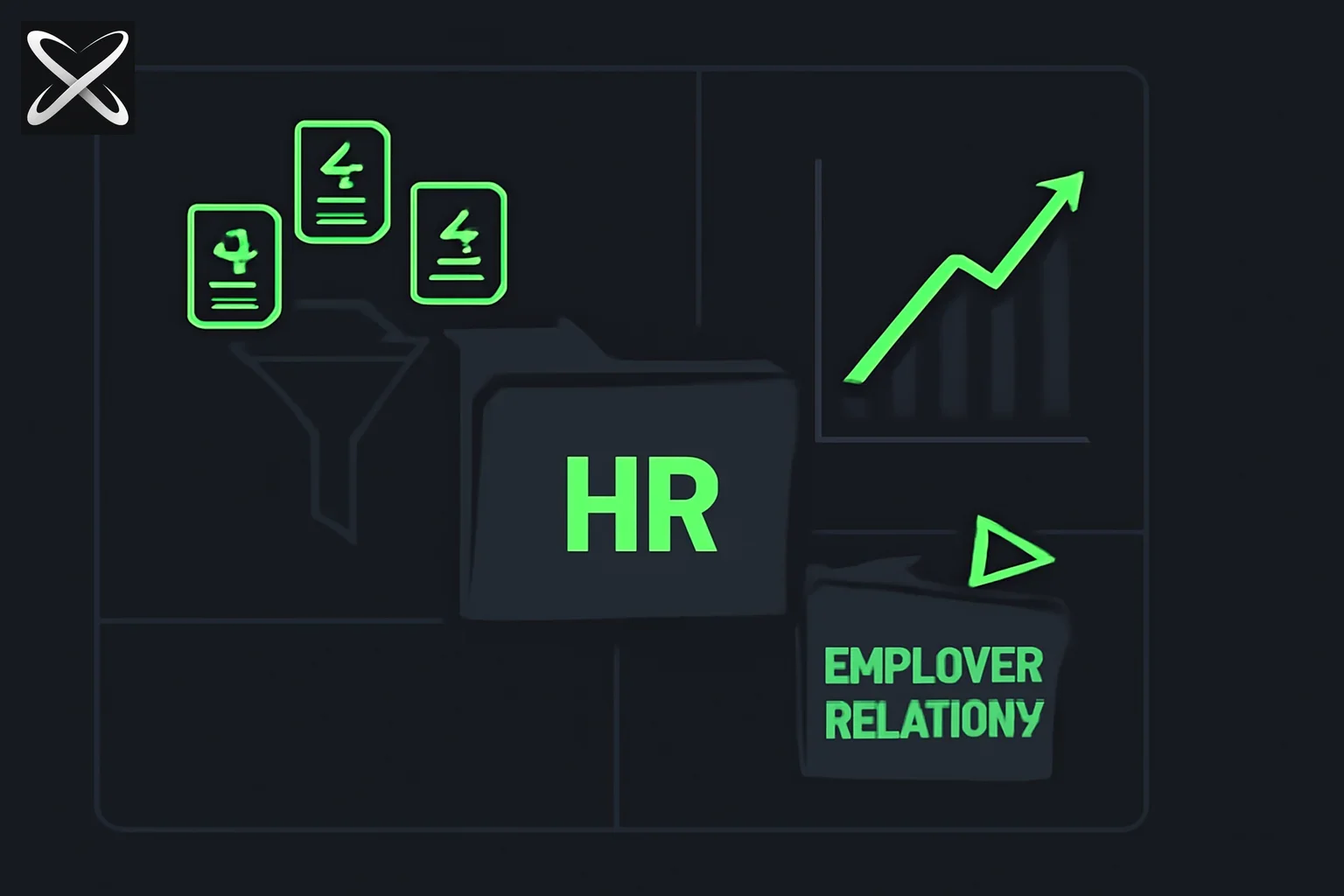 AI for HR diagram: a hiring funnel narrowing resumes beside a rising onboarding growth chart, with a caution flag over sensitive employee relations
Talent acquisition is one of the highest-volume HR functions, which makes it attractive for AI. It is also one of the highest-risk for bias and legal exposure, which makes it an area requiring significant care.
Where AI Helps
Job description drafting: Given a role definition, level, and team context, AI produces first-draft JDs that hiring managers find substantially easier to edit than to write from scratch. The efficiency gain is real, and the output quality is consistently good enough to use as a starting point.
The practical workflow: write a brief describing the role (what problem this person solves, what they own, what success looks like in 90 days), the technical and soft requirements, and the team context. Use AI to expand this into a structured JD. Then review for accuracy, brand voice, and inclusive language before publishing.
Interview scheduling and coordination: AI can manage scheduling logistics — coordinating availability, sending confirmations, handling reschedules — significantly reducing the back-and-forth burden on recruiters for high-volume pipelines.
Intake questionnaire design: Given a role spec, AI can suggest a structured intake form for a hiring manager to complete before opening a role, ensuring that requirements are defined clearly before the search begins.
Where to Be Careful
Resume screening at scale: Tools that use AI to score and filter candidates at scale before human review are legal risk territory in multiple jurisdictions. New York City's Local Law 144 requires bias audits for AI hiring tools. Illinois and Colorado have related requirements. Before deploying any AI that affects which candidates a human sees, consult your legal team and the specific regulations in your operating jurisdictions.
Structured interview scoring: AI tools that score candidates on interview transcripts introduce both bias risk and reliability concerns. Interview transcripts are highly context-dependent, and AI models often misread tone, cultural communication style, and indirect language in ways that disadvantage certain candidate groups.
Any automated rejection: No automated AI-only rejection of candidates without human review. The consequences of error are too significant and the legal exposure too high.
Onboarding
Onboarding is one of the clearest wins for AI in HR — high volume, structured content, and the stakes of any individual error are relatively low (wrong information in an onboarding guide is catchable and correctable).
Content generation: AI is effective at generating onboarding guides, first-week checklists, FAQ documents, and role-specific orientation plans from existing documentation and a brief about the role and team. The content needs review, but the first draft is usually 70-80% of the way there.
Personalization at scale: Onboarding content that is customized by role, team, and level is significantly more effective than generic company-wide materials, but creating it manually for every hire is expensive. AI makes role-specific customization tractable at the per-hire level if you build a template-and-fill system with appropriate review.
Policy Q&A: An AI assistant trained on your HR policies, benefits documentation, and employee handbook can answer routine new hire questions reliably — leave policy, expense reimbursement, IT access requests, payroll schedule. This reduces the "first 90 days" burden on HR and gives new employees faster answers.
For the policy Q&A specifically: invest in the quality of the underlying documentation before the AI layer. A Q&A system built on incomplete or inconsistent policies will produce incomplete and inconsistent answers. The AI makes the retrieval faster; it does not fix documentation gaps.
Learning and Development
L&D is an area where AI changes what is possible more significantly than in most other HR functions.
Curriculum and Content Development
AI substantially reduces the time to produce structured learning content. A learning designer who previously spent four hours building a lesson from research and expertise can now spend two hours on the thinking, and one hour editing an AI-assisted draft.
What this does not change: the expertise required to know whether the content is right. AI will produce plausible-sounding L&D content that sounds organized and complete and contains subtle errors or outdated information. The subject matter expert review step cannot be abbreviated.
Where this compounds well: Creating role-specific variations of the same foundational training material. If you have built a strong foundational module on data privacy, AI can produce variants tailored to marketing, finance, legal, and customer service teams from the same source material — work that previously required rebuilding from scratch for each audience.
Personalized Learning Path Design
AI can analyze an employee's current role, development goals, and skill gaps (assuming you have structured data on these) and suggest learning paths — internal programs, courses, certifications, external resources — that match the gap.
The quality of this depends entirely on the quality of the input data. If your skills inventory and performance data are incomplete or inconsistently maintained, personalized AI path recommendations will reflect those gaps.
L&D Analytics
AI is useful for synthesizing large volumes of qualitative training feedback and surfacing themes — what is working, what is confusing, where the same questions come up repeatedly. This is faster than manual thematic coding and produces reasonably reliable first-pass themes, though a human still needs to verify that the AI-identified themes match the actual pattern in the data.
Employee Relations and HR Business Partnering
This is where the caution line is clearest. Employee relations is high-context, high-stakes, and deeply dependent on judgment that AI does not have.
What AI Helps With
Document drafting: Performance improvement plans, written communications about policy violations, accommodation letters, and similar HR documents require careful language, and AI can produce first drafts that HR professionals then review and adapt. The draft is a starting point, not a final product.
Research: Looking up relevant employment law provisions, regulatory updates, or comparable policy language from other organizations. AI can surface information faster than manual research, with the caveat that legal specifics need verification from authoritative sources or counsel.
Template maintenance: Keeping HR templates (offer letters, promotion letters, separation agreements) current and consistent with policy changes is maintenance work that AI handles well as a drafting assistant.
What AI Should Not Do
Disciplinary or termination decisions: These require human judgment, organizational context, and accountability that AI cannot provide. Any AI involvement in these decisions (analysis, documentation review) should be in service of human decision-makers, not as an input to an automated decision.
Employee investigations: Sensitive employee relations issues involving harassment, discrimination, or misconduct claims require trained investigators who can read context, establish trust, and exercise judgment in ways that depend on interpersonal skill. AI should not be involved in these processes beyond administrative support.
Compensation equity decisions: AI can surface data patterns that warrant investigation, but compensation equity analysis requires statistical expertise, legal review, and human judgment about organizational context. Automated AI compensation decisions are both legally risky and likely to embed historical biases at scale.
Workforce Planning
Strategic workforce planning involves projecting talent needs, identifying skill gaps, and building hiring and development plans against business objectives. AI is useful here as an analytical assistant, not as a planner.
Where AI helps: Synthesizing data from multiple sources (headcount data, performance data, attrition data, business projections) into a summary that surfaces patterns and risks. Generating scenario analyses — "if we grow revenue 30%, what does that imply for team size and skill mix in each function?" — from structured inputs. Drafting board-ready presentations from analysis.
Where human judgment is essential: Deciding how to respond to the patterns AI surfaces. Identifying organizational dynamics — leadership team changes, culture shifts, hidden dependencies — that are not in any dataset. Making trade-off decisions between competing talent priorities under real constraints.
Building Your Own AI Fluency as an HR Professional
HR professionals who are building their AI skills effectively are doing it role-specifically — learning by applying AI to actual HR tasks, not by taking generic AI courses.
The best starting point is a low-stakes, high-volume task you do repeatedly: JD drafting, onboarding checklist creation, or policy FAQ response generation. Pick one, write a precise specification (what are the inputs? what does a good output look like?), run it with an AI tool, and build a verification habit before anything goes out.
From there, expand to more complex tasks as your confidence grows. The verification habit is non-negotiable for every step — not because AI is unreliable in general, but because in HR specifically, an error that reaches an employee has consequences that a catch-before-publish review could have prevented.
For staying current with AI tools and practices, a subscription to a platform like explainx.ai gives you access to a curated skills registry, daily AI news, and monthly course drops — useful infrastructure for HR professionals who want to stay current without spending hours assembling a reading list. The AI learning chatbot is also useful for answering role-specific questions about tool selection and workflow design.
The Framing That Matters Most
The most useful mental model for AI in HR is this: AI extends what you can do, not who is accountable for it.
When AI drafts a job description, you are still accountable for what it says. When AI surfaces a candidate, you are still accountable for who gets hired. When AI generates onboarding content, you are still accountable for its accuracy. The accountability structure of HR does not change because AI is involved — what changes is the speed at which you can get to a draft, the volume at which you can operate, and the quality of the starting point.
The HR professionals who are navigating this transition well are not the ones who automated the most decisions. They are the ones who used AI to spend less time on the mechanical parts of their work so they could spend more time on the parts that require human judgment — the cases that do not fit templates, the conversations that cannot happen through a chatbot, the decisions that depend on understanding an individual in their context.
That trade — mechanical work to AI, judgment work to humans — is the durable formula for how AI belongs in HR.
Related reading on explainx.ai
More AI-for guides
- Building an HR agent for employee onboarding in Copilot Studio — a practical build guide for the benefits Q&A and onboarding-checklist use case, with the human-escalation line this guide argues for
- AI for Business Leaders — workforce AI strategy and accountability framing
- The AI Readiness Checklist for Business Leaders — the Policy dimension covers exactly the written-rules-vs-improvised gap HR usually owns
- AI for Consultants and Analysts — org-design and change-management adjacent workflows
- AI for Mental Health — EAP tools, wellbeing apps, and clinical governance for HR buyers
- AI for Elderly Care — caregiver benefits and aging workforce considerations
Broader context
- Knowledge Worker Guide to AI Agents — what employees are actually doing with agents day to day
- Human-in-the-Loop AI — approval gates for high-stakes HR actions
- AI Tools by Role pathway — function-specific tool directories including HR