PitchLense analyzes startup risk across 9 categories from pitch decks and reports, returning structured JSON scores, ris
 by
by Add new capabilities to Claude beyond text generation
Example: Access external data sources, execute code, interact with tools and services
Transform Claude from chatbot to action-taking agent
Provide Claude with access to relevant context and data
Example: Load project documentation, access knowledge bases, query databases
Get more accurate, context-aware responses
Automate multi-step workflows combining AI and external tools
Example: Research → Summarize → Create document → Send notification
Complete complex tasks end-to-end without manual steps
Time estimate: 15-60 minutes depending on server complexity
Prerequisites
DeepSeek
DeepSeek offers an AI-powered chatbot and writing assistant for chat completions, writing help, and code generation with
Backlinks (Ahrefs)
Use Backlinks (Ahrefs) for detailed SEO analysis. Check website backlinks, anchor text, domain rating & more with this b
Artemis
Artemis: Connect to the Artemis API to build and manage crypto data-analysis formulas for price, fees, revenue and time-
ToolFront
ToolFront is a knowledge database software and db management system offering unified access to databases with advanced t
Basic Memory
Basic Memory is a knowledge management system that builds a persistent semantic graph in markdown, locally and securely.
Strong directory entry: PitchLense surfaces stars and publisher context so we could sanity-check maintenance before adopting.
According to our notes, PitchLense benefits from clear Model Context Protocol framing — fewer ambiguous “AI plugin” claims.
Useful MCP listing: PitchLense is the kind of server we cite when onboarding engineers to host + tool permissions.
We wired PitchLense into a staging workspace; the listing’s GitHub and npm pointers saved time versus hunting across READMEs.
Strong directory entry: PitchLense surfaces stars and publisher context so we could sanity-check maintenance before adopting.
Useful MCP listing: PitchLense is the kind of server we cite when onboarding engineers to host + tool permissions.
I recommend PitchLense for teams standardizing on MCP; the explainx.ai page compares cleanly with sibling servers.
PitchLense reduced integration guesswork — categories and install configs on the listing matched the upstream repo.
We wired PitchLense into a staging workspace; the listing’s GitHub and npm pointers saved time versus hunting across READMEs.
Strong directory entry: PitchLense surfaces stars and publisher context so we could sanity-check maintenance before adopting.
showing 1-10 of 52
Share your MCP server with the developer community
Select a client to integrate this server.
Claude Desktop configuration
{
  "mcpServers": {
    "pitchlense-mcp": {
      "command": "uvx",
      "args": [
        "pitchlense-mcp"
      ],
      "env": {
        "GEMINI_API_KEY": "",
        "SERPAPI_API_KEY": "",
        "PERPLEXITY_API_KEY": ""
      }
    }
  }
}Analyzes startup investment risk by processing pitch decks and financial documents, providing structured risk assessments across 9 categories with numerical scores and recommendations.
PitchLense is a community-built MCP server published by connectaman that provides AI assistants with tools and capabilities via the Model Context Protocol. PitchLense analyzes startup risk across 9 categories from pitch decks and reports, returning structured JSON scores, ris It is categorized under ai ml, analytics data.
You can install PitchLense in your AI client of choice. Use the install panel on this page to get one-click setup for Cursor, Claude Desktop, VS Code, and other MCP-compatible clients. This server runs locally on your machine via the stdio transport.


🏆 WINNER !!! of Google Cloud Gen AI Exchange Hackathon under the problem statement “AI Analyst for Startup Evaluation.” 🏆 Competing among 278,000+ participants and 180,000+ teams nationwide
A comprehensive Model Context Protocol (MCP) package for analyzing startup investment risks using AI-powered assessment across multiple risk categories. Built with FastMCP and Google Gemini AI.
PitchLense is a comprehensive AI-powered startup analysis platform that provides detailed risk assessment and growth potential evaluation for early-stage ventures. The platform analyzes multiple dimensions of startup risk and provides actionable insights for investors, founders, and stakeholders.





Watch our comprehensive tutorial video to learn how to use PitchLense effectively:
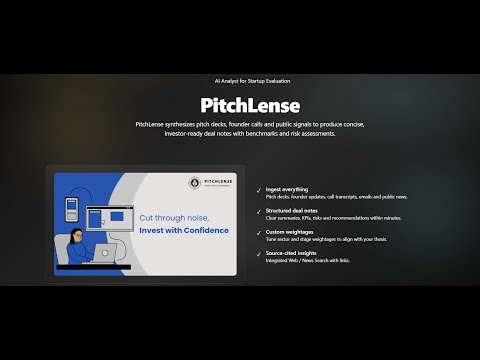
Click the image above to watch the tutorial on YouTube
| Category | Key risks |
|---|---|
| Market | Small/overstated TAM; weak growth; crowded space; limited differentiation; niche dependence |
| Product | Early stage; unclear PMF; technical uncertainty; weak IP; poor scalability |
| Team/Founder | Single-founder risk; churn; skill gaps; credibility; misaligned incentives |
| Financial | Inconsistent metrics; high burn/short runway; optimistic projections; unfavorable CAC/LTV; low margins |
| Customer & Traction | Low traction; high churn; low retention; no marquee customers; concentration risk |
| Operational | Fragile supply chain; unclear GTM; operational inefficiency; poor execution |
| Competitive | Strong incumbents; low entry barriers; weak defensibility; saturation |
| Legal & Regulatory | Grey/untested areas; compliance gaps; disputes; IP risks |
| Exit | Unclear pathways; low sector exit activity; weak late‑stage appeal |
pip install pitchlense-mcp
git clone https://github.com/pitchlense/pitchlense-mcp.git
cd pitchlense-mcp
pip install -e .
git clone https://github.com/pitchlense/pitchlense-mcp.git
cd pitchlense-mcp
pip install -e ".[dev]"
cp .env.template .env
# edit .env and fill in keys
Supported variables:
GEMINI_API_KEY=
SERPAPI_API_KEY=
PERPLEXITY_API_KEY=
# Create sample data
pitchlense-mcp sample --output my_startup.json

# Run comprehensive analysis
pitchlense-mcp analyze --input my_startup.json --output results.json
pitchlense-mcp quick --input my_startup.json --output quick_results.json
pitchlense-mcp server
from pitchlense_mcp import ComprehensiveRiskScanner

# Initialize scanner (reads GEMINI_API_KEY from env if not provided)
scanner = ComprehensiveRiskScanner()

# Provide all startup info as one organized text string
startup_info = """
Name: TechFlow Solutions
Industry: SaaS/Productivity Software
Stage: Series A

Business Model:
AI-powered workflow automation for SMBs; subscription pricing.

Financials:
MRR: $45k; Burn: $35k; Runway: 8 months; LTV/CAC: 13.3

Traction:
250 customers; 1,200 MAU; Churn: 5% monthly; NRR: 110%

Team:
CEO: Sarah Chen; CTO: Michael Rodriguez; Team size: 12

Market & Competition:
TAM: $12B; Competitors: Zapier, Power Automate; Growth: 15% YoY
"""

# Run comprehensive analysis
results = scanner.comprehensive_startup_risk_analysis(startup_info)

print(f"Overall Risk Level: {results['overall_risk_level']}")
print(f"Overall Risk Score: {results['overall_score']}/10")
print(f"Investment Recommendation: {results['investment_recommendation']}")
from pitchlense_mcp import MarketRiskAnalyzer, GeminiLLM

# Initialize components
llm_client = GeminiLLM(api_key="your_api_key")
market_analyzer = MarketRiskAnalyzer(llm_client)

# Analyze market risks
market_results = market_analyzer.analyze(startup_info)
print(f"Market Risk Level: {market_results['overall_risk_level']}")
The package provides a complete MCP server that can be integrated with MCP-compatible clients:
from pitchlense_mcp import ComprehensiveRiskScanner

# Start MCP server
scanner = ComprehensiveRiskScanner()
scanner.run()
The primary input is a single organized text string containing all startup information (details, metrics, traction, news, competitive landscape, etc.). This is the format used by all analyzers and MCP tools.
Example text input:
Name: AcmeAI
Industry: Fintech (Lending)
Stage: Seed

Summary:
Building AI-driven credit risk models for SMB lending; initial pilots with 5 lenders.

Financials:
MRR: $12k; Burn: $60k; Runway: 10 months; Gross Margin: 78%

Traction:
200 paying SMBs; 30% MoM growth; Churn: 3% monthly; CAC: $220; LTV: $2,100

Team:
Founders: Jane Doe (ex-Square), John Lee (ex-Stripe); Team size: 9

Market & Competition:
TAM: $25B; Competitors: Blend, Upstart; Advantage: faster underwriting via proprietary data partnerships
Tip: See examples/text_input_example.py for a complete end-to-end script and JSON export of results.
All tools return structured JSON responses with:
{
    "startup_name": "Startup Name",
    "overall_risk_level": "low|medium|high|critical",
    "overall_score": 1-10,
    "risk_categories": [
        {
            "category_name": "Risk Category",
            "overall_risk_level": "low|medium|high|critical",
            "category_score": 1-10,
            "indicators": [
                {
                    "indicator": "Specific risk factor",
                    "risk_level": "low|medium|high|critical",
                    "score": 1-10,
                    "description": "Detailed risk description",
                    "recommendation": "Mitigation action"
                }
            ],
            "summary": "Category summary"
        }
    ],
    "key_concerns": ["Top 5 concerns"],
    "investment_recommendation": "Investment advice",
    "confidence_score": 0.0-1.0,
    "analysis_metadata": {
        "total_categories_analyzed": 9,
        "successful_analyses": 9,
        "analysis_timestamp": "2024-01-01T00:00:00Z"
    }
}
Steps
Troubleshooting
✓ Do
✗ Don't
💡 Pro Tips
Architecture
Model Context Protocol standardizes how AI hosts (Claude, Cursor) communicate with external tools and data sources through server implementations.
Protocols
Compatibility
✓ Use when
Use when you need Claude to access external data, execute actions, or integrate with tools. Best for extending AI capabilities beyond conversation.
✗ Avoid when
Avoid when native integrations exist (use official APIs directly), for real-time critical systems, or when security/compliance requires zero external dependencies.
Excel
Unlock powerful Excel automation: read/write Excel files, create sheets, and automate workflows with seamless integratio





