




Update — September 30, 2026: Anthropic now says Mythos-class end-to-end exploit rates have arrived in open-weight GLM-5.3 (12% vs Mythos Preview 14% on ExploitBench; Glasswing still cited at 10,000+ vulns; Mythos 5.1 via trusted access). Full eval.
Update — August 21, 2026: Anthropic upgraded Claude Security's scans to run on Mythos 5, public beta for Enterprise, plus a new $35M Defender Advantage Fund for open-source patching — Mythos 5 itself still stays behind the scan with no direct model access.
Update — July 23, 2026: Anthropic opened Claude Security to public beta for Claude Enterprise — scan, adversarial-validate, and patch vulnerabilities, plus a Claude Code plugin. Built on the same models Anthropic says it uses to secure its own codebase.
Update — July 21, 2026: Sakana AI's new Fugu-Cyber orchestrator reports 86.9% on CyberGym and 72.1% on CTI-REALM, which Sakana calls comparable to Mythos-Preview. Its gated Token Plan and verification-harness thesis offer a Japan-centered answer to the same dual-use problem documented below. Read the balanced Fugu-Cyber analysis →
Update (June 13, 2026): Fable 5 and Mythos 5 have been suspended globally following a US government export control directive. The cybersecurity capabilities documented in this blog — specifically Mythos's ability to analyse codebases and identify software vulnerabilities — are at the centre of the government's jailbreak concern. Ironically, Anthropic's own defence is that the same capability exists in GPT-5.5, and that security defenders use it daily. The detailed documentation in this blog and in Anthropic's own system cards may have supplied the government with the evidence it needed to act. Full story: why the US government banned Fable 5 and what it means for AI safety.
Update (June 9, 2026): Polymarket prediction markets show a 92% probability that Anthropic will release Claude Mythos publicly by June 30, 2026, with some sources suggesting tomorrow. Read our analysis: Anthropic Mythos Public Release: Polymarket Odds Surge to 92%
Claude Mythos Preview is Anthropic's newest general-purpose model, but the story that broke through to practitioners in early April 2026 is narrower and sharper: in controlled evaluations, it appears far more capable than prior Claude generations at end-to-end offensive security work—not only spotting bugs, but building exploits, including on long-dormant code paths in widely trusted stacks. Anthropic's technical write-up lives on Assessing Claude Mythos Preview's cybersecurity capabilities (April 7, 2026, on red.anthropic.com). Their consumer-facing framing for the defensive program is Project Glasswing.
This article summarizes what Anthropic says it measured, what it can and cannot prove in public today, and how online discussion is interpreting the moment—without treating forum anecdotes as established fact.
Update: May 2026 — Project Glasswing reports 10,000+ vulnerabilities found
On May 23, 2026, Anthropic announced that Project Glasswing and its partners have discovered more than 10,000 high- or critical-severity vulnerabilities in essential software since the program launched last month. This represents a dramatic acceleration in vulnerability discovery at scale.
Key implications from Anthropic's update:
- Patching volume challenge: While fixing these vulnerabilities will make software ecosystems safer, Anthropic warns that "the software industry will need to adapt to the volume of vulnerabilities that models like Claude Mythos Preview will be able to find."
- Coordinated disclosure at scale: With over 10,000 findings in roughly one month, traditional CVD (coordinated vulnerability disclosure) processes—which typically handle tens to hundreds of reports—face operational strain.
- Defensive vs. offensive race: The discovery rate suggests that automated AI vulnerability research is no longer experimental; it's producing actionable findings faster than many organizations can patch.
Anthropic's initial Project Glasswing update emphasizes that this is an ongoing collaborative effort with critical software maintainers, open-source projects, and security partners to systematically harden widely deployed systems before similar capabilities become broadly accessible.
For defenders, the takeaway is stark: patch velocity and automated response workflows are no longer "best practices"—they're essential infrastructure in an environment where AI-assisted vulnerability discovery operates at industrial scale.
 Claude Mythos Preview — cybersecurity evaluation themes
What Anthropic is claiming (at a glance)
The post’s thesis is blunt: Mythos Preview represents a step change in model-driven vulnerability research and exploit development, strong enough that Anthropic is not planning general availability and is instead routing early access through Project Glasswing partners (critical vendors, open-source maintainers, and coordinated defense work).
Anthropic also argues a familiar dual-use lesson: patching and exploitation share machinery. Models that reason better about code can help defenders and attackers; the open question Anthropic foregrounds is who scales responsible workflows first during a potentially “tumultuous” transition.
Benchmarks and statistics worth bookmarking
The blog leans on comparative, quantitative claims. These are vendor-reported; treat them as directional until third parties replicate under published conditions.
| Area | Anthropic-reported result (April 2026) |
|---|---|
| Firefox 147 JS exploit harness | Opus 4.6: 2 working exploits / several hundred tries; Mythos: 181 working exploits + 29 with register control (footnote [1] clarifies sandbox omissions) |
| OSS-Fuzz ladder (tiers 1–5) | Sonnet 4.6 / Opus 4.6: ~150–175 tier-1 crashes, ~100 tier-2, one tier-3 each; Mythos: 595 at tiers 1–2, 10 tier-5 hijacks on fully patched targets |
| Human severity agreement | 89% exact match vs. expert triagers on 198 manually reviewed reports; 98% within one severity level |
| Disclosure backlog | <1% of findings fully patched at time of writing, per Anthropic’s CVD pacing |
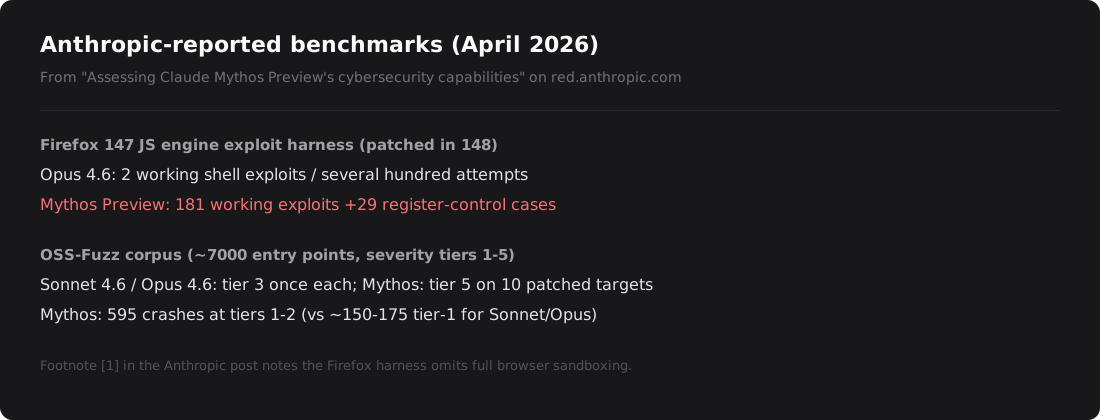 Summary diagram of Anthropic-reported Opus vs Mythos benchmark contrasts
How they evaluated it (the “agentic scaffold”)
Anthropic describes a repeatable containerized setup: source and binary under test, Claude Code driven by Mythos Preview, and a prompt amounting to “find a security vulnerability.” The agent reads code, runs the program, iterates with debuggers or instrumentation, and returns either a negative result or a report plus proof-of-concept.
Operational details that matter for interpreting scale:
- Parallelism: different agents target different files to reduce duplicate findings; files are ranked 1–5 for “interestingness” before deep dives.
- Triage pass: a final Mythos agent filters reports that are technically true but low real-world impact.
- Validation: memory corruption classes are easier to confirm with tools like AddressSanitizer; logic bugs are harder to certify automatically.
For zero-days, Anthropic argues the epistemic bar is higher than “did the model memorize a CVE?”—a novel bug cannot be “in the training set” as a published vulnerability. The tradeoff is public verifiability: readers mostly get summaries, one detailed FreeBSD case study (CVE-2026-4747, NFS / RPCSEC_GSS stack corruption with a multi-packet ROP chain), and cryptographic commitments (SHA-3 hashes) for undisclosed work.
Public case studies Anthropic chose to detail
Beyond statistics, the post spotlights a few narratives useful for defenders:
- OpenBSD TCP SACK — a subtle interaction leading to a remote crash class bug; Anthropic notes a 27-year lineage and discusses integer overflow in sequence comparisons.
- FFmpeg H.264 — a 16-year issue involving sentinel collision in slice tables; Anthropic argues fuzzing-heavy projects can still miss structural invariants LLMs surface.
- FreeBSD NFS RCE — CVE-2026-4747: unauthenticated root via constrained stack ROP, chained across RPCs; Anthropic emphasizes this was fully autonomous after the initial prompt, contrasting with human-guided success on prior models in third-party work they reference.
Anthropic also discusses N-day exploitation (public patches, slow deployment) as a safe demonstration surface: models can turn CVE + commit hash into working privilege-escalation chains quickly—implying patch velocity becomes a first-class security control.
What people are saying on Reddit (and why tone matters)
Anthropic’s post is long, technical, and—by necessity—partially non-verifiable until disclosures complete. That gap is where public forums do their work.
Representative discussion clusters include:
- r/Anthropic — “Claude Mythos: The model Anthropic is too scared to…” and parallel threads on r/claude and r/ClaudeCode.
- Alarm / urgency: dual-use scaling, compressed N-day windows, and unease about asymmetric access while Mythos-class models are not GA.
- Skepticism: accusations of strategic storytelling, discomfort with headline-grade claims when most evidence is still private, and reminders that vendor demos are not peer review.
- Epistemic hygiene: the constructive middle path is to separate documented commitments (CVD timelines, hashes, a small set of public CVEs) from comment-section lore—especially unverified stories that should not be repeated as fact in serious threat models.
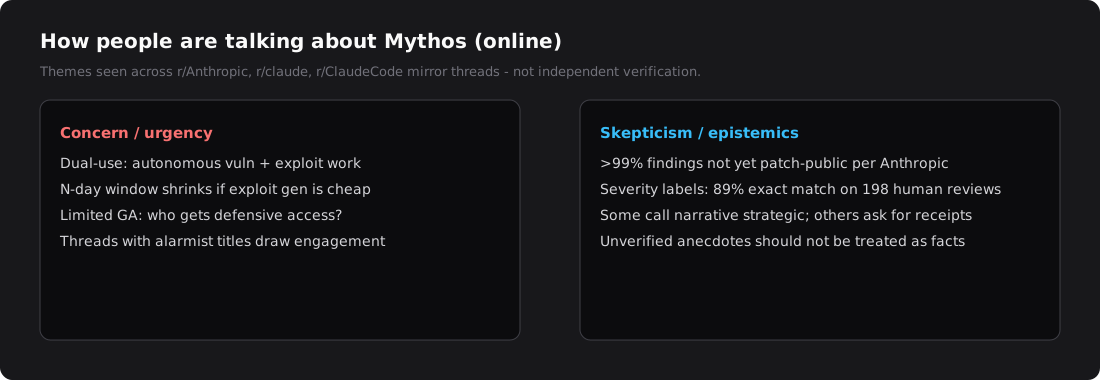 Axes of online discourse around Mythos (illustrative, not a poll)
Practical takeaways for builders (defense-first)
Anthropic’s own closing guidance—useful even if you never touch Mythos—boils down to operational maturity:
- Start now with today’s frontier models for bug finding, triage, patch drafting, and review assistance; skills and scaffolds compound.
- Shorten patch cycles and treat dependency updates with CVE fixes as incident-grade work when autonomous exploit generation is cheap.
- Refresh disclosure and incident pipelines; model-discovered volume may overwhelm human-only triage.
- Invest in hardening that is not “friction-only”; mitigations that merely slow humans may not slow massively parallel agents.
At explainx.ai, we care about the same structural shift from a different angle: agent tooling (skills, registries, evaluation harnesses) is how organizations encode responsible workflows. If you are standardizing how engineers prompt and instrument models, browse the skills registry and see how teams publish reusable playbooks—for example our post on SEO + GEO agent skills for content systems, which is adjacent in the sense that clear sourcing, structured answers, and explicit limitations are how trustworthy posts survive both search and LLM citation.
Sources and further reading
- Anthropic, Assessing Claude Mythos Preview’s cybersecurity capabilities (April 7, 2026).
- Anthropic, Project Glasswing.
- Anthropic, Coordinated vulnerability disclosure operating principles.
- Community discussion (interpret as opinion, not verification): r/Anthropic thread, r/claude mirror, r/ClaudeCode mirror.
If your team is shipping custom agents with governance requirements, book a demo or register to list skills and tools in one place your org can trust.
Update — July 29, 2026: VulnCheck 1H 2026 finds AI-assisted discoveries are not exploited at a higher rate than baseline (~1.3% KEV) — useful counterweight to Glasswing hype without dismissing the capability.
Related: What Is an AI Jailbreak? · Why the US Government Banned Fable 5 and Mythos 5 · VulnCheck: AI-found bugs exploit rate
Update — August 14, 2026: Anthropic's own ExploitBench testing put a specific number on Mythos Preview's exploit capability referenced above — arbitrary code execution on 21 of 41 real V8 CVEs, against a best public-model result of 2 of 41.
Update — October 7, 2026: Anthropic folded Project Glasswing into a three-tier Cyber Verification Program. See the tiers, eligibility and how to apply.
Update — October 8, 2026: Anthropic opened OSS Scanner, a free opt-in scan service for open-source maintainers. See how it works and who should enroll.